










How can we structure responsible communication on a daily basis?

96% of investors surveyed indicate that CSR issues play a key role in investment decision-making. Companies with good ESG performance are not only better valued, but also perceived as more resilient, more innovative, and better prepared for future challenges.
In this context, communication is no longer just a marketing tool. It has become a major strategic issue for aligning values, actions, and stakeholder perceptions. It is no longer enough to talkabout commitment or ecological transition: it must be demonstrated with facts, data, and overall consistency. This is where responsible communication comes in.
CSR communication involves conveying useful, verifiable, and sober messages that are in line with environmental, social, and economic issues. This requires rethinking communication levers, gradually implementingeco-design, and providing better training for teams.
Contents
Understanding environmental and CSR issues related to communication
An impact that is still largely underestimated
Contrary to popular belief, communication, whether digital or printed, has a real environmental impact. According to ARCEP, digital technology already accounts for 3 to 4% of global greenhouse gas emissions, and this figure could double by 2025 if no eco-responsible measures are taken.
In the communications sector, every campaign has a carbon cost: emailing, video distribution, social media, mass printing... All these practices consume resources (servers, paper, energy), making carbon assessment essential.
It is worth noting that, globally, more than 306 billion emails were sent in 2021, with an estimated 376 billion expected to be sent in 2025, according to a study conducted by the Carbon Literacy Project. The environmental impact of sending emails is significant, accounting for no less than 150 million tons of CO2e in 2019, or 0.3% of the global carbon footprint.
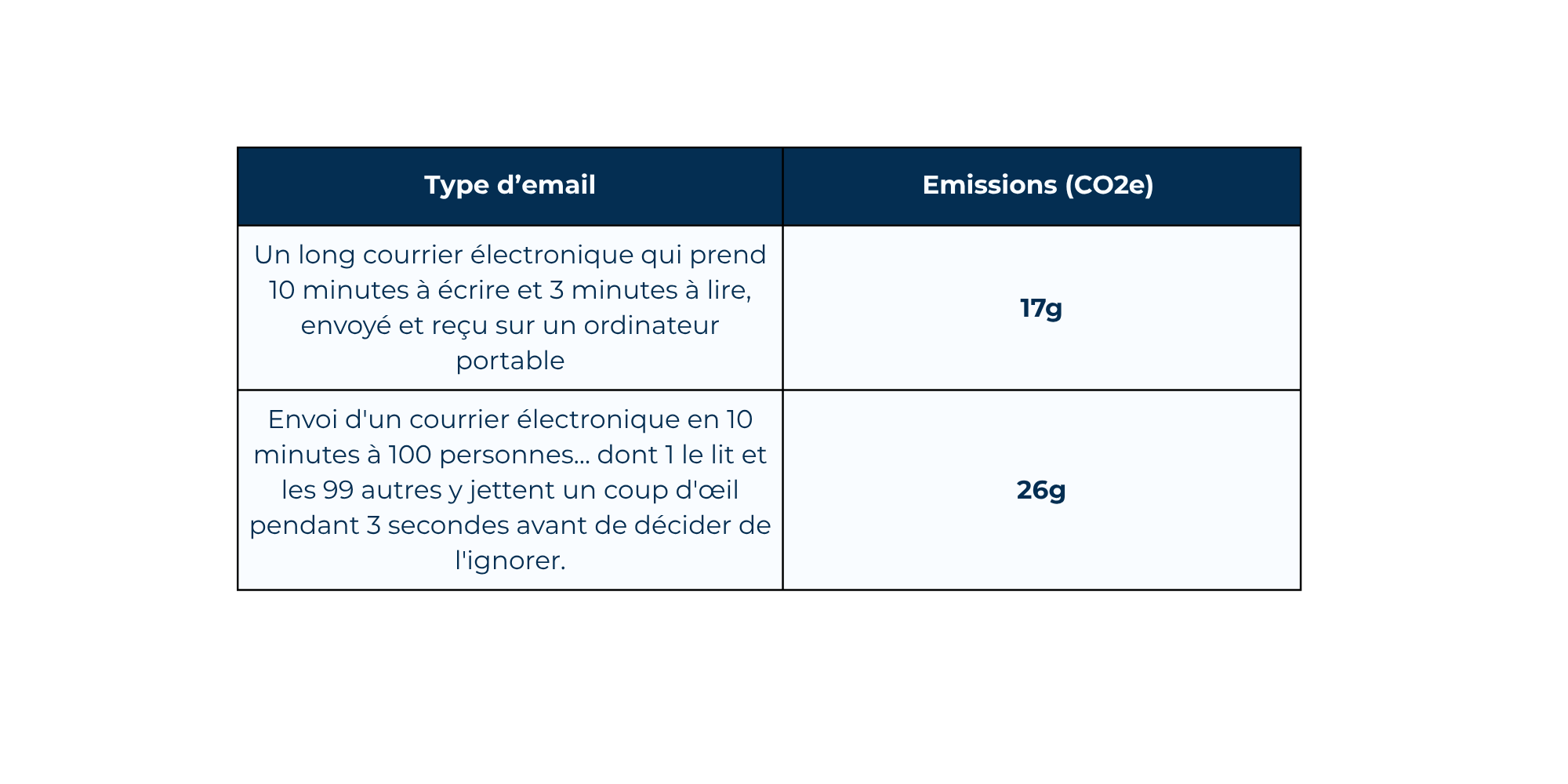
High expectations from stakeholders
Stakeholders —investors, customers, employees, communities—now expect companies to demonstrate consistency between their commitments and their actions. Effective marketing communication can no longer be disconnected from the reality of the initiatives implemented in the field.
On the investor side, the trend is clear: 51% of them say that their organization now incorporates ESG expertise and data into portfolio management and investment decisions.
Employees themselves are driving this change. According to a survey conducted by CSA for ADEME and LinkedIn, 71% of employees say they are taking action to promote environmental transition in their company. Their involvement reinforces the legitimacy of the commitments made, provided that these are also promoted through responsible communication.
On the consumer side, expectations are just as high. According to the Kantar Barometer 2023, 86% of French people say they are aware of the environmental and social impact of brands.
In response, two out of three consumershave already decided against making a purchase because of this impact.
These figures show that communication must not only inform, but also:
- Promoting CSR initiatives,
- Justify the commitments made,
- Above all, incorporate measurable and verifiable data.
💡 C’est dans cette logique que s’inscrit Decarbo’Target®, la solution développée par Decarbo’Solution® (Decarbo’Solution®). Elle permet aux structures de cartographier les émissions de gaz à effet de serre liées à leurs activités de communication (supports, campagnes, événements), et d’objectiver leur message en s’appuyant sur des données consolidées, conformes aux référentiels internationaux (SBTi, ISO 14064…).
Master a new vocabulary to ensure the long-term future of your company.
Concretely reducing the environmental impact of its communications
The implementation of eco-responsible practices
The implementation of responsible communication relies above all on transforming practices: we are talking here abouteco-design, i.e., thinking about the impacts right from the message design phase.
Examples of responsible practices:
- Reduce the size of attachments, compress images, ban auto-play videos
- Choose certified service providers (Imprim’Vert printing, eco-designed hosting)
- Opt for lightweight, simple, and accessible websites
- Prioritize useful channels for priority targets (relevance principle)
For 40% of companies, eco-designing products and services is a way to anticipate future regulations.
💡 Grâce à Decarbo’Supply®, les entreprises peuvent intégrer les données spécifiques de leurs fournisseurs (agences, imprimeurs, développeurs web, etc.) dans leur bilan GES. Cela permet de construire une politique de communication durable fondée sur des indicateurs réels.
Using the right levers for measured communication
The selection of responsible communication tools must be guided by two criteria:
- The effectiveness of the message (usefulness, target audience)
- The environmental impact of the canal
Today, there are practical, sector-specific communication guides, such as those published by ADEME and APCC, to help companies make these choices. But tools alone are not enough: it is the combination of content, means, and CSR consistency that makes eco-responsible communication so powerful.
💡 Decarbo’Solution® helps teams track emissions associated with each channel (digital, print, events) and integrate this data into a comprehensive sustainability action plan.
👋 Impact on purchasing behavior
Greenwashing directly affects individuals' trust and purchasing behavior.
According to a recent study conducted by Green Finance:
- 64% of consumers have already stopped buying a product or brand after discovering a greenwashing strategy.
- 76% of people under 35 say they are particularly attentive to false environmental claims.
- 80% of consumers want access to effective platforms/software to detect greenwashing.
This growing mistrust complicates the task of genuinely committed companies, which must redouble their efforts to prove the sincerity of their CSR commitments.
Our carbon footprints show that the biggest impacts of our events are linked to spectator and participant travel, as we organize popular "off-stadium" competitions.
Establishing a corporate culture centered on responsible communication
Train teams and embed reflexes
All too often, CSR communication remains confined to a dedicated department or team, when it should permeate the entire company. However, this responsible approach can only work if all employees understand the climate issues at stake and the levers that are being used to address them.
However, employees themselves are willing to get more involved. According to ADEME, 68% of employees want to go further and receive training on sustainability issues.
Training thus becomes a strategic lever for :
- Giving meaning to new sustainable practices
- Creating a shared culture of ethical and responsible communication
- Empower all business lines: HR, marketing, digital, purchasing, events...
- Facilitate the implementation of CSR at all levels of the company
Chez Decarbo’Solution®, nous sommes convaincus qu’aucun plan d’actions ne peut s’opérer sans une compréhension en profondeur des parties prenantes. Decarbo’Solution® propose des formations et un accompagnement sur mesure pour aider les entreprises à intégrer la durabilité au cœur de leur stratégie.
To achieve this, we support you at every stage of your environmental transition, through :
👩🎓Une training in climate issues
A course structured into 4 modules:
- Climate and energy fundamentals
- Methodological approach to GHG assessments
- Préparer son Bilan avec Decarbo’Solution®
- Drawing up a balance sheet and reducing emissions
🤝Des ateliers “Fresque du Climat” par Decarbo’Solution®
Our carbon engineers, trained and experienced in running La Fresque du Climat, are available to organize these workshops directly within your company, facilitating your teams' commitment to a concrete climate strategy.
Au-delà de la sensibilisation, Decarbo’Solution® vous accompagne dans la réduction de votre empreinte carbone sur le long terme, grâce aux divers outils disponibles sur notre plateforme.
Formalize an internal guide to responsible communication
To ensure the transformation is sustainable, it is essential to structure eco-responsible practices within an internal framework:
- Rules for digital sobriety
- Best practices for printing
- Sustainable graphic charters
- Distribution recommendations (volumes, targeting)
This responsible communication guide must be part of an overall corporate strategy, approved at the highest level. It then becomes a reference tool for all employees and a marker of the organization's CSR maturity.
💡 The data generated via Decarbo’Solution® can be used as a basis for this internal guide, providing accurate indicators on the emissions associated with communication.

Implementing responsible communication does not mean limiting messages or stifling creativity. Rather, it involves rethinking communication practices so that they are aligned with environmental issues, stakeholder expectations, and the company's overall sustainable development policy.
Faced with more vigilant consumers, committed employees, and investors attentive to ESG criteria, every company must demonstrate consistency between its CSR commitments and the way it communicates them.
This implies:
- To assess the realimpact of its communication tools,
- To implement an eco-design policy,
- To train teams,
- And to structure its choices in a shared internal guide.
By using Decarbo’Solution®, organizations can integrate these dimensions into their carbon footprint and identify the emissions associated with their communication materials. Ultimately, this enables them to develop a sustainable communication policy based on reliable, consolidated, and verifiable data.