








Low-carbon standards and certifications: understanding and anticipating new standards in sustainable construction

Faced with the climate emergency and the continued rise in greenhouse gas emissions, the building sector plays a central role in the ecological transition. In France and across Europe,low-carbon strategies arenow essential drivers of sustainable development, encouraging construction industry players —companies, project owners, architects, and local authorities—to rethink their practices in order to significantly reduce their carbon footprint.
Low-carbon standards and certificationsnow form the basis of this transformation. They provide a clear, measurable, and verifiable framework for managing emissions reduction at every stage ofa project'slife cycle, from design to deconstruction. Based onISO standardsandinternationallyrecognizedcarbon labels, these approaches not only quantify greenhousegas (GHG)emissions, but also promote carbonoffsetting efforts andprojects certifiedas having a low environmental impact.
Beyond regulatory requirements, adopting a low-carbon strategy reflects a commitment to innovation and responsibility. It engages organizations in a processofemissions reduction,independent verification, and transparency, while strengthening their competitiveness in the face of newinternational standards.
Therefore, understanding the mechanisms of carbon certificationand mastering LCA (life cycle assessment) standards, and anticipating future requirements of the certification framework are are becoming strategic priorities for companies that want to actively contribute to carbon neutrality in the construction sector.
Contents
The foundations of the low-carbon framework
Understanding the concept of low carbon and its link to sustainable development
The concept oflow carbonrefers to an approach that aims to rethink production, construction, and consumption methods in order to limit overall environmental impact. It is fully in line with the logic ofsustainable development, seeking to reconcile economic performance, social responsibility, and the preservation of natural resources.
In France, this approach is based on thenational low-carbon strategy, which sets out the broad guidelines for achieving climate neutrality by 2050. Public and private actors are thus encouraged to measure theirecological footprint, identify their mainsources of emissions, and implement concrete long-termreductionmeasures.
In the construction sector, this translates into the design of more modest structures, incorporating materials with low environmental impact and favoring an approach based onlife cycle assessment (LCA). The objective is clear: to control every stage of the process, from the production of materials to deconstruction, in order to limitgreenhouse gasesand actively contribute to theecological transition.
The role of ISO standards and the international regulatory framework
Standardsplay a key role in structuring environmental approaches.The International Organization for Standardization (ISO)has defined several major standards, including the ISO 14064 and ISO 14067 series, which provide a framework for measuring and reporting the environmental impacts of organizations and products.
These standards guarantee the reliability of assessments and facilitate their international recognition. In France, they are linked to the Bilan Carbone® method and thelow-carbon label, a voluntary certification scheme. voluntary certification scheme that recognizes and promotes projects to greenhouse gas (GHG) emission reduction or carbon sequestration.
This mechanism is based on proven methods, transparent governance, and a rigorous monitoringframework, ensuring consistency between public and private initiatives.
Companiesthat commit to this initiative enjoy increased recognition, while strengthening the credibility of their environmental efforts among their partners, investors, and customers.
The Carbon Footprint® and the MRV (Measurement, Reporting, Verification) methodology
Anycredible approach relies on accurate data. TheMRV(Measurement, Reporting, Verification) method forms the backbone of any serious environmental assessment system.
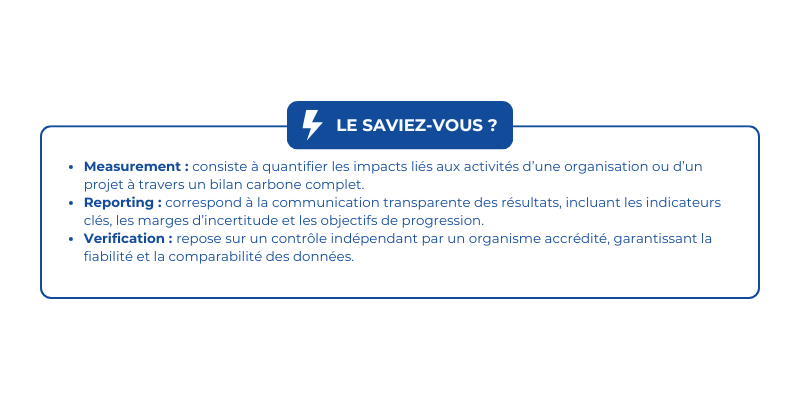
Cette méthodologie, inspirée des standards internationaux, assure la crédibilité des démarches menées sur le terrain. Elle est aujourd’hui adoptée par de nombreux acteurs, dont Decarbo’Solution® (Decarbo’Solution®), qui propose une plateforme numérique facilitant la collecte, l’analyse et la restitution des données environnementales.
The role of public and private actors in defining the low-carbon framework
The success of an ambitious climate policy depends on close coordination between the state, local authorities, economic actors, and civil society. TheMinistry for Ecological Transitionis steering the national strategy and supporting local initiatives through measures such as thelow-carbon labeland financial aid provided by Bpifrance.
For their part,companiesand initiative leaders voluntarily commit to measurable measures, often certified according toISO standards, in order to demonstrate their contribution toreducingclimate impacts. These measures are part of a processof continuous improvement, sometimes incorporatingcompensation mechanismswhen certain residual emissions cannot be avoided.
Enfin, les plateformes spécialisées comme Decarbo’Solution® jouent un rôle stratégique en facilitant la mise en œuvre opérationnelle : elles accompagnent les organisations dans le calcul de leur empreinte environnementale, la mise en place d’actions de réduction des émissions de GES et le suivi dans le temps.
This is how a coherent ecosystem is built, based on trust, transparency, and cooperation, serving a genuine transformation towards a sustainable and resilient economy.
Low-carbon labels, standards, and initiatives
Overview of the main labels in France and Europe
Environmental labelsplay a key role in promotingprojectscommitted to a more responsible economy. In France, theLow Carbon Label, initiated by the Ministry of Ecological Transition, is a national benchmark.
- It guarantees that a project effectively contributes to the objectives of the National Low Carbon Strategy (SNBC) and France's climate goals.
- It allows carbon credits for carbon reductions or sequestration in various sectors (agriculture, transportation, construction, waste, forestry, etc.).
- It is based on approved methodologies, ensuring traceability, external verification, and compliance with the principles of permanence, additionality, and uniqueness.
Its purpose is to officially recognizeprojectsthat contribute to improving sustainable land management.
Once approved,projectsare recorded in a publicregister, ensuring their traceability and transparency.
At the international level, initiatives such as theGold Standardand theVCS (Verified Carbon Standard)help to harmonize approaches. These mechanisms ensure overall consistency, promoting trust and comparability betweenprojectscarried out in different countries.
Labelsthus offer tangible recognition to project leaders while supporting a collective dynamic around sustainability and environmental performance.
Reference frameworks and evaluation approaches
To ensure their credibility, environmentalprojectsrely on technical standards that define the rules for monitoring and evaluation. The starting point is always abaseline scenario, which describes the initial situation before any action is taken. This scenario serves as a basis for measuring progress over time.
Eachprojectmust then produce areportdetailing the results obtained, the calculations made, and the actions taken. This document becomes the basis for review for official recognition of the project.
International standards, such as ISO 14064andISO 14067, provide a consistent framework for these approaches. They define the principles to be followed in order to evaluate results and ensure their comparability on a global scale.
The objective is to ensure transparency, rigor, and reliability in monitoring, while promoting a measurable and reproducible approach.
Project generation and development
Once actions have been taken and results confirmed, recognizedprojectsreceive official validation. Each successful initiative can lead to the creation of units representing the progress made, which are recorded in a specificregister. These units can be retained, shared, or exchanged between actors, depending on the mechanisms in place.
This recognition system is based on transparency and traceability: each registered unit is unique and linked to a specificproject. This ensures reliable monitoring and builds stakeholder confidence.
These initiatives offer numerous benefits: they promote public recognition of the efforts made, stimulate competitiveness, and strengthen the credibility of the actors involved. They also encourage a sustainable approach based on evidence and measurement rather than intention.
Additional commitments
Many actors choose to support external missions in order to extend their commitment to sustainability. These initiatives involve financial contributions to programs that promote the restoration of natural environments, reforestation, or the development of renewable energies.
These actions, often recognized bylabels, contribute to multiple benefits: soil restoration, biodiversity preservation, support for local communities, and job creation. They reflect a desire to act both locally and globally, in a spirit of shared responsibility.
By combining innovation, rigor, and solidarity, these additional commitments reinforce the credibility of the actors involved and support the implementation of concrete initiatives in the service of environmental sustainability.
The driving sectors: agriculture, forestry, energy, and construction
Environmentalprojectsare developing in key sectors where there is significant room for improvement.
- Inagriculture, they promote farming methods that respect the soil and biodiversity.
- In theforest, they support sustainable management, fire prevention, and reforestation.
- In theenergy sector, they support the deployment of renewable sources such as solar, wind, and biomass.
- Finally,constructionis exploring new avenues througheco-design, the use of bio-based materials, and waste reduction.
Thesecertified projectsdemonstrate that it is possible to combine technical performance, sustainability, and social responsibility. By promoting cooperation between different stakeholders, they contribute to the overall transition towards a more sober, efficient, and environmentally friendly economy.
We aim to meet ministerial requirements and guidelines by promoting more responsible sports and raising awareness among our members and the general public.
Anticipating new benchmarks in sustainable construction
Integrate sustainability from the design stage
The transformation of the building sector is based on a comprehensive approach where environmental performance is considered from the earliest stages of an architectural project. Designing a sustainable building now means taking into account its entirelife cycle (LCA)—from the extraction of materials to deconstruction—by seeking to limit waste and optimize resource management.
Eco-designis therefore becoming an essential lever. It involves choosing recycled or bio-based materials, favoring low-impact construction processes, and reducing energy consumption throughout the building's life cycle. This approach is based on a logic of anticipation: every technical decision and every design choice must be guided by the desire to minimize environmental pressures.
European regulations, meanwhile, are gradually tightening requirements for sustainable performance. The goal is clear: to encourage the creation of buildings that are more energy-efficient, more resilient, and capable of adapting to future environmental conditions.
The role of digital tools and monitoring platforms
La digitalisation est devenue un pilier de la stratégie environnementale du secteur. Des plateformes comme Decarbo’Solution® (Decarbo’Solution®) offrent des outils capables d’évaluer et de suivre les indicateurs de performance liés à la durabilité. Ces solutions permettent d’assurer la traçabilité des actions et d’améliorer la gestion des engagements dans le temps.
Environmental BIM(Building Information Modeling) is also a major asset. By integrating environmental parameters into the digital model of a building, it becomes possible to simulate several scenarios and choose the most responsible options even before construction begins.
This digital approach promotes cooperation between architects, engineers, project owners, and local authorities. It ensures better coordination and optimizes technical performance while controlling design and operating costs.
Gradual harmonization at the international level
The construction sector is evolving in a context where standards and requirements are becoming increasingly similar worldwide. This gradual harmonization facilitates the comparability of initiatives and reinforces the credibility of sustainable approaches.
Reference bodies, public institutions, and private actors are working together to define shared criteria for evaluation and traceability. This collaboration helps to simplify mutual recognition of approaches and increase transparency in trade.
Environmental labelsalso contribute to this dynamic. They enable stakeholders to quickly identify the most ambitious and reliable initiatives, while providing clarity on the efforts made in each country. This international convergence promotes the spread of a common culture of sustainability in the building sector.
Roadmap to environmental neutrality
The search for sustainable balance in the construction sector is based on a series of complementary actions. This approach is structured around three stages:
- Measure to understand: assess the impact of activities and identify priority areas for improvement.
- Acting to transform: integrating innovative materials, high-performance energy systems, and circular processes.
- Monitor to progress: ensure continuous monitoring, adjust strategies, and promote progress to stakeholders.
This progress requires collective commitment and cooperation between public, financial, and technical stakeholders. Organizations such asBpifrancesupport innovative initiatives in sustainable construction by assisting those with ideas and projects that have strong environmental potential.
Achieving environmental neutrality is therefore not a utopian dream, but a structured approach based on consistency, moderation, and innovation.
The driving role of players in the construction industry
Architects, engineers, project owners, and local authorities play a central role in transforming the sector. Their decisions determine the sustainable performance of tomorrow's buildings.
These players are getting involved in the design process at an increasingly early stage, incorporating strategies based on sustainability, simplicity, and innovation. Collaboration between different trades is becoming essential: it allows buildings to be viewed as living systems, capable of evolving over time and meeting the needs of future generations.
This collective dynamic paves the way for a construction model based on responsibility and performance. By acting together, those involved in the building industry are not only constructing more energy-efficient and sustainable buildings, but also building a shared vision of a more balanced and environmentally friendly future.

The evolution of the construction sector and sustainability is now based on a structured, measurable, and shared dynamic, where each player must be part of a coherent and ambitious carbon plan . This approach goes well beyond regulatory requirements, drawing onrecognized standardsandmanagement toolscapable of quantifying, monitoring, and improving environmental performance over time, while making a concrete contribution toclimate neutrality.
When integrated into an overall low-carbon strategy,carbon offsetmechanisms enable residual emissions to be balanced throughcertified, traceable projects with a significant positive impact. They therefore complement existing reduction efforts in a measurable and transparent manner.
Les outils numériques jouent, dans ce contexte, un rôle décisif. Ils offrent la possibilité de collecter des données précises, de modéliser différents scénarios carbone et d’assurer un pilotage continu des trajectoires de réduction. C’est dans cette logique qu’intervient la Decarbo’Solution®, une approche intégrée développée par Decarbo’Solution® pour accompagner les organisations dans leur décarbonation.
Among its most strategic building blocks,Decarbo’Target®stands out for its ability tosteer low-carbon trajectoriesand transform diagnostics into concrete action plans. Based on arigorous MRV methodology, it helps building stakeholders move from a measurement-based approach to an action-based approach, while ensuring thetraceabilityandcredibilityof the commitments made.
By combiningISO standards,environmental labels, anddigital solutionssuch as Decarbo’Solution®, companies now have a solid operational framework for structuring their climate strategy. This combination ofassessment,reduction, andrecoveryforms the basis for a successful transition to carbon neutrality.
Public policies, such ascarbon taxesandenergy performance regulations, reinforce this momentum by establishing a consistent incentive framework. At the same time, voluntary approaches—driven by businesses, architects, and local authorities—play a key role in accelerating the spread of best practices.
Achievingenvironmental neutralityis no longer an abstract ideal, but aconcrete, measurable, and transparentprocess. It relies on our collective ability tomeasure accurately,act consistently, andmake progress over time.
By relying on solutions such asDecarbo’Solution®, building industry players have a powerful lever at their disposal to transform their climate ambitions into measurable actions. Amore sober, more responsible construction model that is fully aligned with climate imperatives—a model where technology, transparency, and cooperation become the true foundations of sustainability.